Many homeowners considering solar energy savings solutions underestimate how complex proper solar installation can be. While going solar promises long-term savings and environmental benefits, mistakes during planning and installation can dramatically reduce efficiency, increase costs, or even create safety risks. Recognizing these pitfalls early—and knowing how to avoid them—helps ensure a system’s performance, longevity, and financial return.
What Are the Most Common Installation Mistakes That Undermine Solar Energy Savings Solutions?
One of the biggest errors in solar installation is skipping or underestimating the site assessment. Without a careful evaluation of the roof’s structure, orientation, tilt, and shading, key performance losses can occur. Roof assessments should consider nearby trees, chimneys, or buildings that cast shadows during peak sunlight hours.
Another common mistake is incorrect system sizing. Many homeowners either undersize or oversize their PV array—resulting in insufficient energy generation or unnecessary equipment cost. Using past utility data and forecasting future energy needs (for example, adding electric vehicles or storage) is essential for a well-proportioned system.
Component selection and compatibility issues also arise. For instance, choosing an inverter that doesn’t match the PV panel’s electrical characteristics—or neglecting battery‑inverter compatibility when storage is involved—can impair performance or damage hardware.
Skipping proper permitting and regulation compliance is another grave risk. Local building codes, electrical standards, and interconnection policies vary widely, and failure to adhere can delay or invalidate the project.
Why Poor Panel Placement and Orientation Can Thwart Solar Savings
A frequently overlooked pitfall is incorrect panel orientation and tilt angle. If panels are not aligned properly—such as facing true south (in many U.S. regions)—or are tilted incorrectly according to latitude, their energy production may fall far short of expectations.
Shading is closely linked to this: even partial shade from trees or chimneys can cut production drastically. Surface-level planning without shadow‑path analysis may result in mismatches between prediction and real output.
In addition, inadequate ventilation for inverters or batteries can become a problem. Inverters generate heat, and without proper airflow, their efficiency drops and longevity suffers.
How Faulty Mounting and Wiring Introduce Structural and Safety Risks
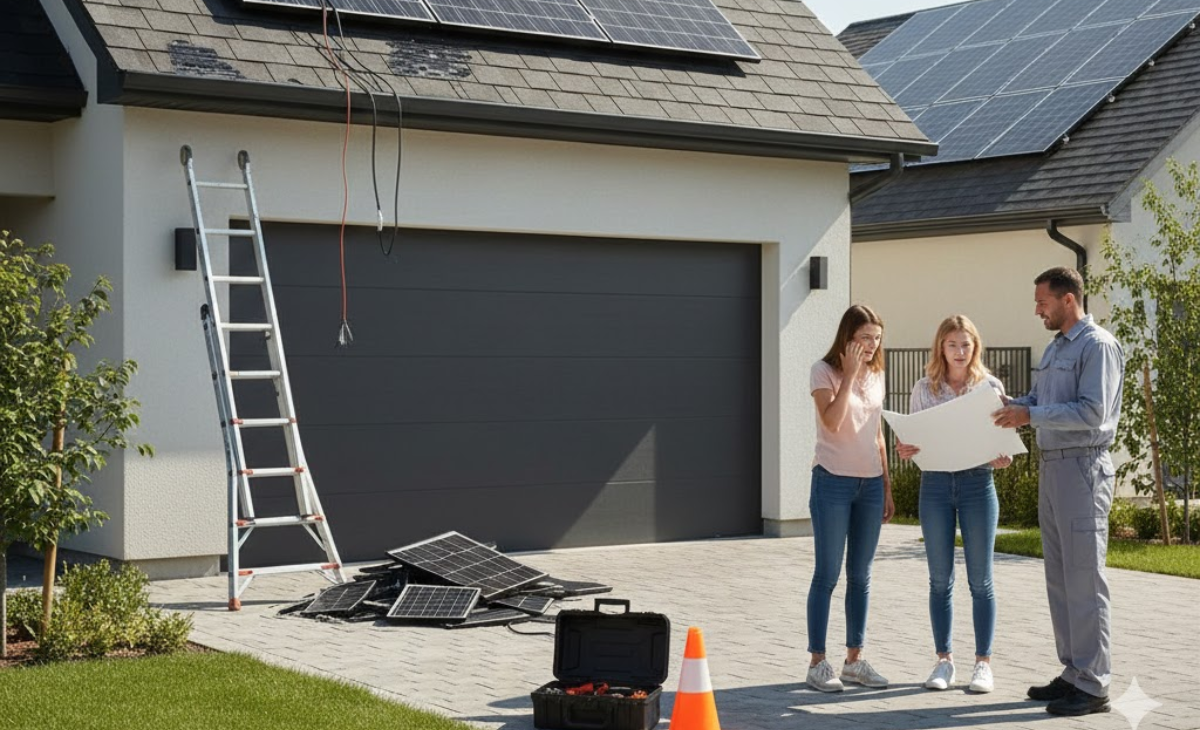
Physical installation errors—especially in mounting and racking—pose serious risks. Poorly secured panels can loosen, damage the roof, or even collapse in high winds. Without proper flashing and sealing, leaks may develop, undermining both system integrity and roof health.
Electrical wiring is another critical area. Loose connections, wrong wire gauge, or poor grounding can degrade system performance and pose serious fire hazards. Grounding must be done correctly: under‑grounded systems may not safely handle faults or lightning.
Furthermore, wire management errors—tangled or exposed wiring—can lead to rodent damage, UV degradation, or mechanical stress over time.
Why Inverter Configuration and Commissioning Matter for System Efficiency
The inverter functions as the heart of a solar system, converting DC from panels into usable AC. When inverters are mismatched, improperly configured, or oversized/undersized relative to the PV array, performance suffers.
Commissioning—i.e., the final verification and testing of all electrical connections—is often rushed or insufficient. Without a rigorous commissioning process (voltage testing, configuration, communications checks), latent issues like misconfiguration or weak electrical connections can go undetected.
Moreover, neglecting to set up proper system monitoring is a common mistake. A lack of monitoring means that underperformance or faults can persist unnoticed, reducing savings and increasing risk.
Structural and Durability Mistakes That Hurt Long-Term Reliability
One major pitfall is installing solar on roofs that are not structurally ready. Installing panels on aging roofs or roof surfaces that are near the end of their service life can lead to future rework, leaks, and even system removal.
Using low-quality modules or mounting hardware is also risky. Cheap panels may degrade faster; inferior racking systems may not tolerate strong wind, causing early failure.
Panel damage during installation—such as microcracks or delamination—can significantly reduce output. Such problems often stem from mishandling, overtightening frame bolts, or poor structural design.
Why Skipping Permits and Compliance Undermines More Than Just Legality
Ignoring local regulations and permit requirements is a critical error. Each municipality may require specific permits, inspections, and adherence to electrical or building codes. Skipping these steps can lead to fines, denied inspections, or decommissioning.
Furthermore, poor documentation and lack of proper handoff education for homeowners can lead to confusion later. Without understanding how to read monitoring data or maintain the system, the homeowner may not be able to intervene when issues arise.
The Risk of Neglecting Maintenance and Long-Term Monitoring
A common but underestimated pitfall involves a lack of maintenance. Solar systems should be periodically inspected for dirt, shading impact, wiring wear, or mechanical loosening.
Without ongoing monitoring, underperformance may go unnoticed. Monitoring platforms provide critical feedback—highlighting dips in production, inverter faults, or temperature issues.
Degradation mechanisms such as solder bond failure, corrosion, or delamination within solar cells can reduce output over time. Proper preventive maintenance can help mitigate these risks.
How Financial and Safety Risks Emerge from Poor Installation
When a solar system is installed incorrectly, financial returns get jeopardized. Lower energy production, safety problems, or system failure can delay payback or erase savings potential altogether.
There are also insurance and liability issues: if a system was installed in violation of electrical codes or without sufficient grounding, an insurance company might refuse claims for fire or structural damage. Homeowners need to consider how installation quality affects both performance and coverage.
Mid-Article Internal Link to Encourage Deeper Reading
Many of these pitfalls could be mitigated by pairing a proper installation strategy with a broader strategy: exploring Solar Energy Savings Solutions: How to Cut Your Energy Bills and Go Green helps homeowners understand not just how to build a system, but how to optimize its long-term economics and environmental impact.
Common Solar Installation Pitfalls vs. Solutions
| Pitfall | Impact | How to Avoid / Mitigate |
| Poor site assessment & shading | Reduced energy output | Do thorough 3D shading analysis; inspect roof orientation and structure |
| Incorrect system sizing | Undersized = insufficient power; oversized = wasted cost | Use historical energy data and forecast future demand |
| Faulty mounting or racking | Roof leaks, structural damage | Use correct mounting hardware, properly seal penetrations |
| Wiring & grounding mistakes | Fire risk, performance loss | Ensure tight connections and proper ground |
| Inverter misconfiguration | Efficiency loss, system shutdown | Commission with detailed testing and check inverter settings |
| No monitoring or maintenance | Undetected faults, long-term decline | Install monitoring software & schedule regular inspections |
| Skipping permits | Legal & safety non-compliance | Engage early with local authorities; secure all permits |
Five Frequently Asked Questions (FAQs)
Q1: How will shading from trees or nearby structures affect my solar output?
Shading—even small or intermittent shade—can reduce the energy production of a solar system significantly. To avoid this, site assessment during installation should analyze shading throughout the year, and system design should account for obstructions.
Q2: Can a poorly matched inverter harm my solar system?
Yes. Using an inverter with incompatible voltage, current, or MPPT settings can limit power conversion, reduce efficiency, or potentially damage system components over time.
Q3: Why is proper grounding so important?
Grounding ensures that fault currents (from lightning strikes or system faults) can safely travel to the ground. Without correct grounding, there’s a heightened risk of electric shock, fire, or catastrophic system failure.
Q4: Do I really need a monitoring system?
Absolutely. Monitoring helps track performance in real time, quickly identifies faults or underperformance, and ensures that your solar energy savings solutions continue working as intended—maximizing your return.
Q5: What happens if I skip getting a permit for my solar installation?
Skipping permits can void project approvals, prevent grid interconnection, or result in fines. It may also invalidate warranties if installation isn’t performed to code.
Conclusion
Avoiding common pitfalls in installing a solar energy system is essential to unlocking the full benefits of solar energy savings solutions. From thorough site assessment and correct system sizing to reliable mounting, wiring, commissioning, and ongoing maintenance, each step of the installation process matters. Skipping any of these can compromise system performance, safety, and financial returns.
By prioritizing best practices, engaging experienced professionals, or using solid design tools, homeowners can mitigate risk and build a reliable, high‑performance solar system. Guardian Home Energy stands ready to help homeowners navigate these complexities, offering expert guidance and support to deliver efficient and reliable solar systems.